Hanoi, May 7, 2026, 17:03 ICT
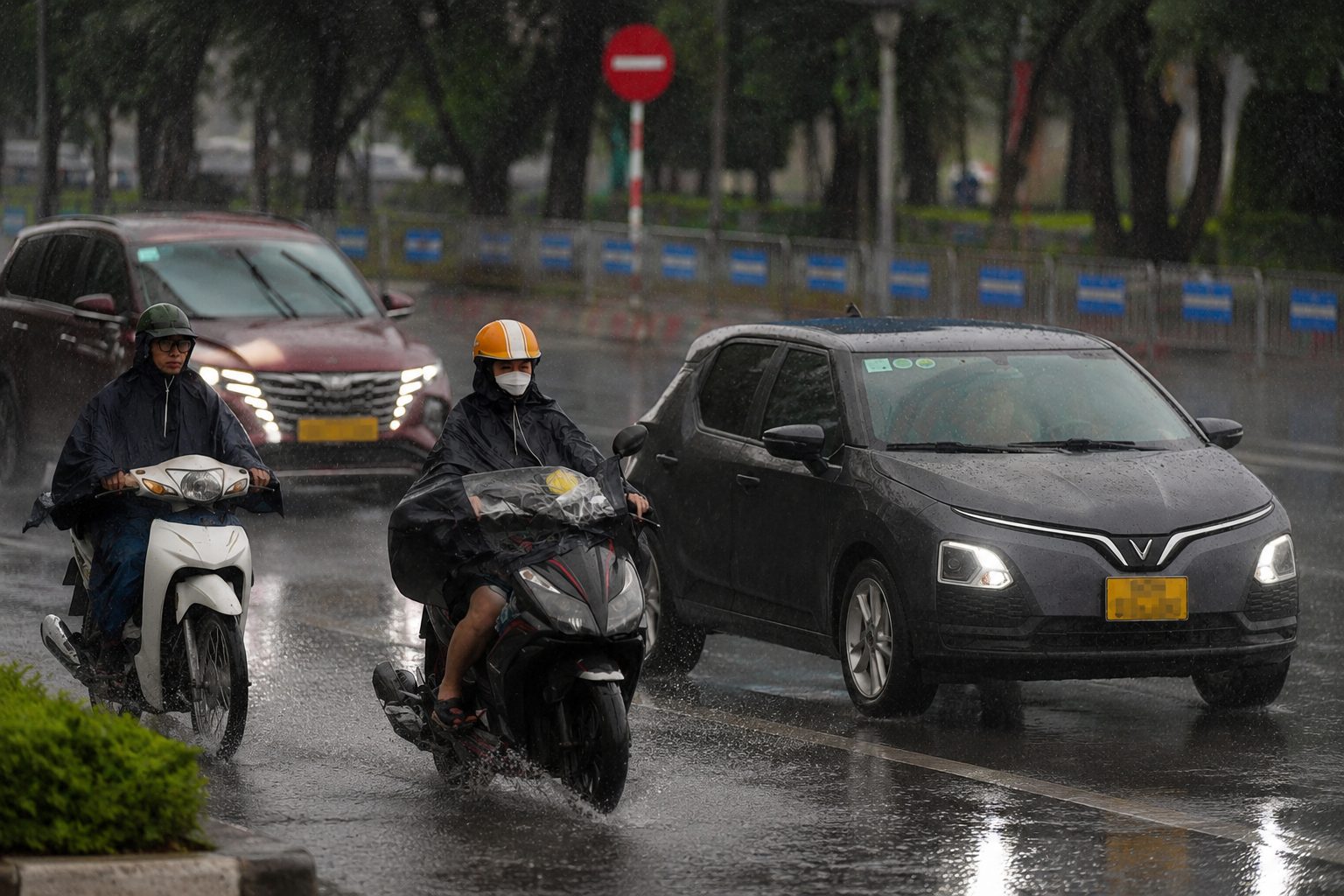
- Vietnam’s national weather agency is flagging heavy rain, hail, lightning, and strong winds for the north, starting Thursday evening and running into Friday.
- Scattered thunderstorms are on tap for Hanoi, with the capital also looking at a cooler night, as satellite and radar picked up convective clouds building over several areas.
- Just days after northern and north-central areas saw unusual early-May hail, authorities issued the warning, flagging heightened risks for homes, crops, roads, and small streams.
Northern Vietnam is set for more heavy rain and storms starting Thursday evening, as a late-season cold front pushes in, the national weather agency warned. Expect hail, lightning, whirlwinds, and flash flood risks. The system will reach the northeast first, then track toward the north-central and sections of the northwest.
Timing is key here. After several days marked by rough transition-season weather—hail hit parts of the north and north-central region—the spell lands just as farmers, commuters, and marine operators brace for another night with unstable conditions.
Northern Vietnam, along with Thanh Hoa and Nghe An, is set for 20–40 mm of rain between Thursday evening and Friday morning, according to the National Center for Hydro-Meteorological Forecasting. Some areas could see more than 100 mm. Rainfall from Ha Tinh down to Hue is expected to range from 10–30 mm, though certain spots may get hit with over 70 mm. Heavy local downpours above 50 mm are also possible in parts of the southwest.
Hanoi sits squarely in the path of the storm. The forecaster pointed to satellite imagery, lightning data, and radar—all indicating convective clouds popping up over Vinh Thanh, Phu Thuong, Tay Ho, Hong Ha and Dong Anh. Showers and thunderstorms could move into the inner districts, with Ngoc Ha, Bo De, and Ba Dinh on watch.
Hanoi will cool down tonight, dropping to 22–24 degrees Celsius before climbing again to 27–29 degrees on Friday. In the northeast, lows are expected between 21 and 24 degrees, though some mountain spots may slip under 21 degrees, according to the centre’s land forecast.
The agency flagged risks offshore as well. Starting early Friday, northeast winds in the northern Gulf of Tonkin are expected at force 4–5, pushing up to force 6 in gusts. Later Friday, winds in the northeastern North East Sea could climb to force 6, with gusts reaching force 7–8 and rough seas likely.
According to Pham Phuong Chi, a forecaster with the National Center for Hydro-Meteorological Forecasting, the most intense rains are expected between the night of May 7 and the end of May 8, VietnamNet reported. Typical rainfall will range from 20–40 mm, though some spots could see more than 100 mm in heavy downpours.
Seasonal forces are at play, but the effects are pronounced. According to Vietnam.vn, which referenced the weather centre, a cold air mass is squeezing a low-pressure trough while upper-level winds converge—conditions that can rapidly trigger thunderstorms.
Nguyen Van Huong, who heads the centre’s weather forecasting department, described the conditions as standard for May’s transition, particularly across northern Vietnam. Here, warmer, humid surface air clashes with cooler layers above, giving rise to powerful vertical storm clouds. Hail, he noted, poses a risk but “not entirely unexpected,” as he told Vietnam.vn. Vietnam
Storms this week reached farther than usual. Nguyen Van Huong told SGGP that between May 2 and May 4, thunderstorms, lightning, hail, and whirlwinds battered a stretch of northern and north-central areas, knocking around localities across the region. Rain totals hit 171 mm at Tan Pheo in Phu Tho, 168 mm at Lam Thao (also in Phu Tho), and 156 mm at Ky Giang in Ha Tinh, according to Huong.
Climate risk lurks in the background, but it doesn’t drive every storm. Voice of Vietnam quoted Nguyen Van Huong, who put the odds of El Niño returning near mid-2026 at 80%–90%. That scenario could dial up the heat, while also making Vietnam more vulnerable to abrupt thunderstorms, hail, and bursts of heavy rain during seasonal transitions.
Rainfall could remain patchy and unpredictable—still a clear risk. The national forecaster flagged the threat from sudden, heavy showers: flash floods might hit smaller rivers and streams, while slopes face landslide potential and low-lying zones could see flooding. Strong winds are also in play, posing hazards for homes, trees, transport infrastructure and crops.